
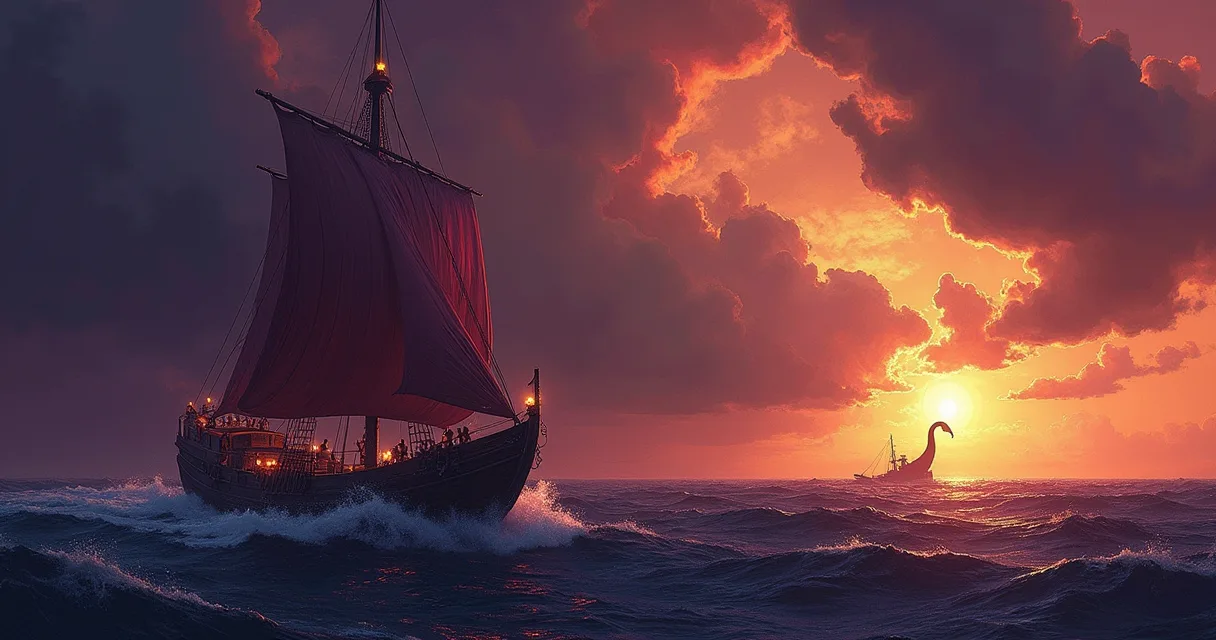
The Real Story Behind The Odyssey: Homer's 2,800-Year-Old Epic, Explained
Seeing the movie? Here's what the poem actually says. Fair warning: the Sirens weren't mermaids, and the Trojan Horse barely shows up.
The oldest story in theaters
Updated July 2026
The biggest movie on the planet right now is based on a 2,800-year-old poem. Christopher Nolan's The Odyssey runs nearly three hours, cost a reported quarter of a billion dollars, and just opened to the largest worldwide debut of Nolan's career. Matt Damon plays a king whose entire mission, for the whole runtime, is to get home.
We're a rewards platform built on Greek mythology. You didn't seriously think we were going to sit this one out.
Most people know it the way they know Titanic, from the poster and a couple of famous scenes and the ending. The actual poem is stranger than that highlight reel, and it spends most of its time nowhere near the monsters, who fill barely a sixth of it. The hero is stuck on islands for most of the decade, a good chunk of that literally crying on a beach. And several things "everyone knows" about this story are flat wrong, starting with the mermaids.
What is The Odyssey actually about?
The Odyssey is the story of Odysseus, king of a small rocky island called Ithaca, trying to get home from the Trojan War. The war takes ten years. The trip home takes ten more. By the time he finally makes it back, he's been gone twenty years, his infant son is a grown man, and more than a hundred suitors have moved into his palace, eating his food and pressuring his wife Penelope to declare him dead and pick one of them.
The Greeks had a word for the thing that powers this whole poem: nostos, the homecoming. Every monster and storm in the poem is just one more thing between him and his own front door.
The famous monster episodes, the Cyclops and the Sirens and all of it, take up four books out of twenty-four, and Odysseus narrates them himself, as a flashback, at a dinner party. The poem's actual present-day action covers about forty days.
How the poem is built
Homer starts in the middle. There's a Latin name for the move, in medias res, and it was coined for this poetic tradition. When the epic opens, the war has been over for ten years and Odysseus is being held by the nymph Calypso, seven years into an island captivity, weeping at the shore.
The hero doesn't even show up for the first four books. The opening belongs to his son Telemachus, a baby when the war started, now a young man sailing around asking aging war heroes whether his father is alive or dead. Scholars call this stretch the Telemachy. By the time you meet Odysseus, you already know exactly what his absence is costing.
He finally appears in Book 5, gets free of Calypso, and washes up half-drowned among the Phaeacians, a seafaring people who take the stranger in and ask for his story. Books 9 through 12 are Odysseus telling his own legend at their banquet, and that's where every famous episode lives. The whole back half of the poem, Books 13 through 24, is the homecoming and what it costs him to finish it.
The monsters
Nearly all of the famous stuff happens in the first year or so. Fresh from Troy with twelve ships, Odysseus raids the Cicones and loses men when they counterattack. Then come the Lotus-Eaters, whose fruit makes his scouts forget home entirely; he has to drag them back to the ships by force. Next is the one everybody remembers, Polyphemus the Cyclops, a man-eating giant, blinded with a sharpened stake after Odysseus tells him his name is "Nobody," so that the giant's cries of "Nobody is hurting me" bring no help. It's the cleverest trick in the poem, and also the most expensive one, because Polyphemus is a son of Poseidon, and the sea god sends every storm that follows.
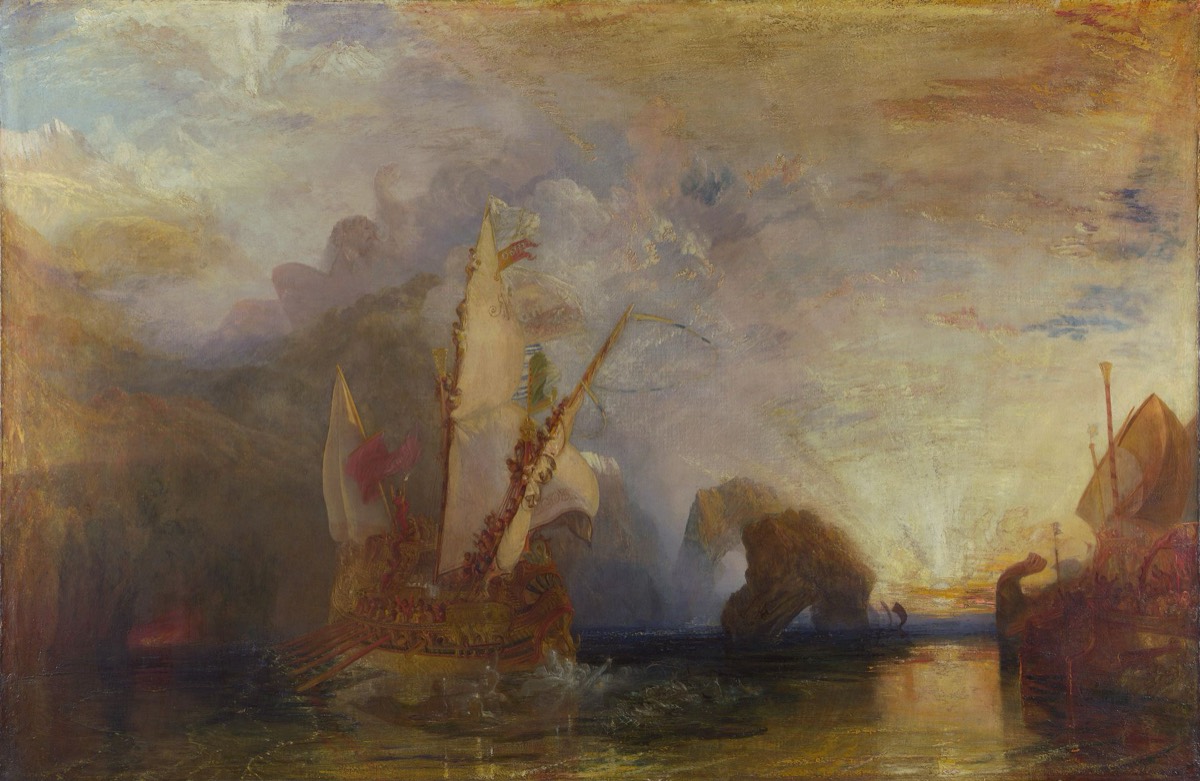 J.M.W. Turner, Ulysses Deriding Polyphemus (1829). The blinded giant is the shadow in the clouds, upper left.
Aeolus, keeper of the winds, gift-wraps every contrary wind in a bag so the fleet can sail straight home. Within sight of Ithaca, close enough to see people tending fires on shore, the crew opens the bag looking for treasure and blows the whole fleet back where it started.
The cannibal Laestrygonians destroy every ship but one. The survivors get past the Sirens (Odysseus lashed to the mast so he can hear the song, the crew's ears plugged with wax), then thread the strait between Scylla, a six-headed monster who plucks six men off the deck, and Charybdis, a whirlpool that swallows ships whole. Finally, starving on the island of the sun god Helios, the crew slaughters his sacred cattle, the one thing they'd been warned about twice. Zeus answers with a thunderbolt that destroys the last ship and every man aboard.
One survivor washes up on a distant island, and the story slows way down.
The waiting
Two women hold Odysseus for most of the decade, and pop culture has been mixing them up forever. Circe, the enchantress of Aeaea, turns his crew into pigs before he outmaneuvers her with divine help. She then flips from enemy to ally to lover, hosts him for one year, and it's Circe who sends him to the edge of the Underworld to consult the dead prophet Tiresias about the way home.
Calypso is the long one. After the shipwreck, the nymph keeps the sole survivor on her island of Ogygia for seven years, and she offers him the one thing no mortal is supposed to refuse: immortality, if he'll stay and be her husband. He turns down living forever and sits on the beach instead, homesick for a rocky little island and a mortal wife. It takes a direct order from Zeus, hand-delivered by Hermes, to make Calypso let him go.
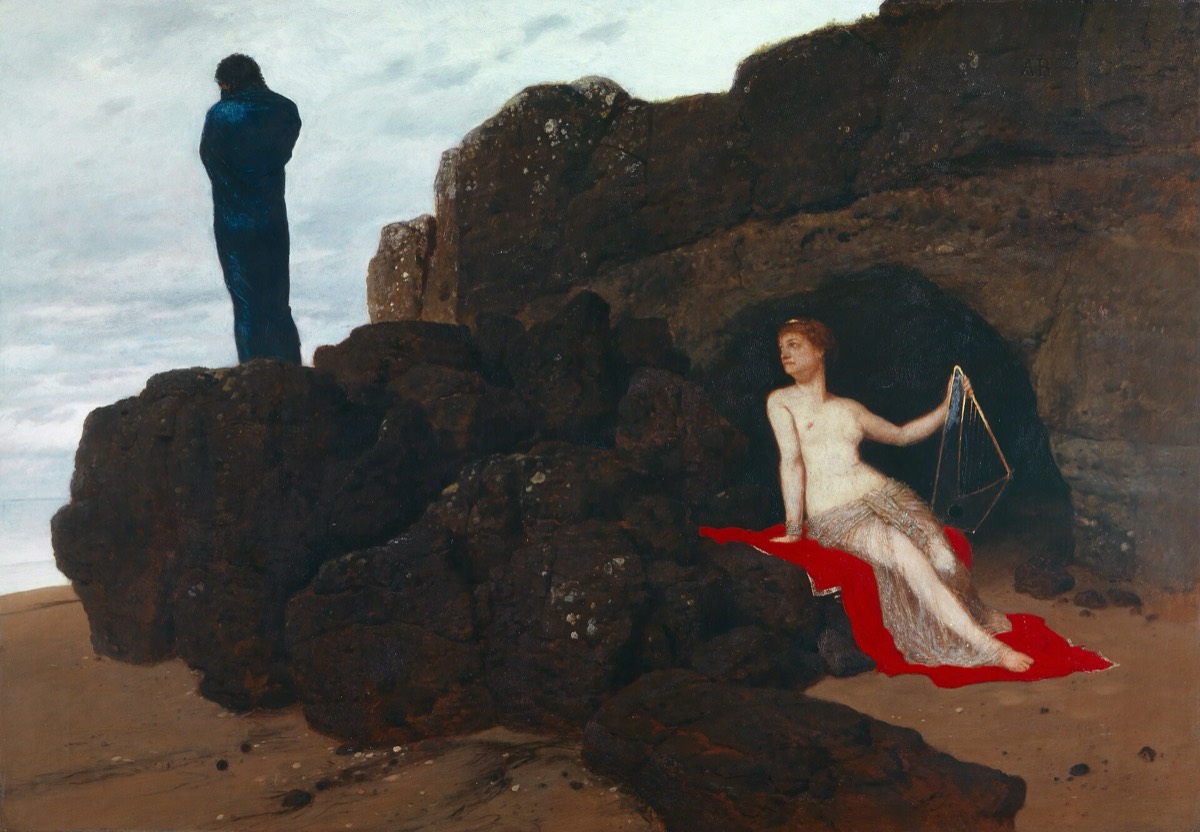 Arnold Böcklin, Odysseus and Calypso (1882). He is looking at the sea again. She notices.
Of the ten years at sea, roughly eight were spent captive on those two islands.
The home front
While Odysseus deals with monsters, Penelope is holding Ithaca against more than a hundred suitors who have moved into the palace, eating and drinking a missing king's wealth while demanding she pick a new husband. Her defense is pure Odysseus. She announces she'll remarry as soon as she finishes weaving a burial shroud for her father-in-law, then unravels each day's work every night. The trick holds for years, until one of her maids gives her away.
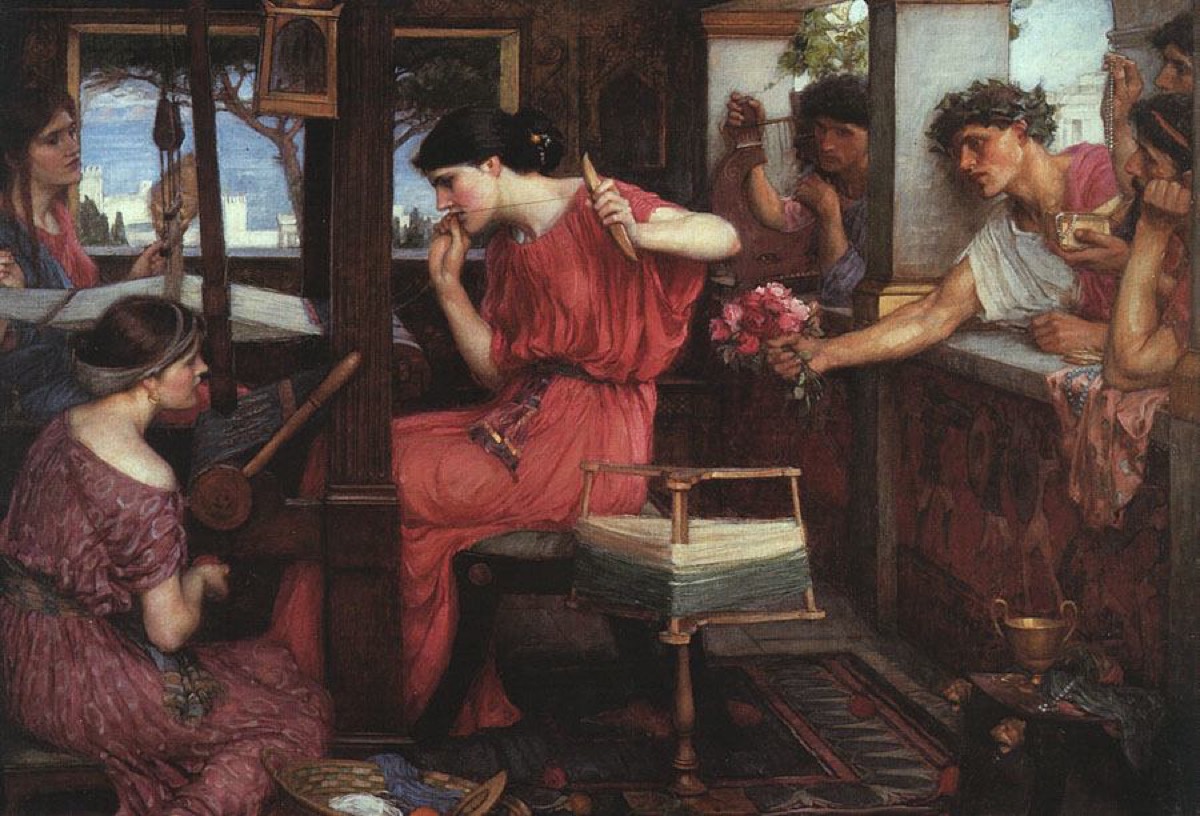 John William Waterhouse, Penelope and the Suitors (1912). The shroud trick in progress; the suitors at the window are getting nowhere.
Telemachus, meanwhile, is growing up fatherless in an occupied house, and his slow change from powerless boy to the man standing beside his father at the end is the poem's second story. Above them both hovers Athena, goddess of wisdom and the family's divine patron, nudging everything toward the homecoming.
There's also a value system running under all of it, one Homer grades nearly every character by: xenia, the sacred code of hospitality between hosts and guests. The Phaeacians, who feed a shipwrecked stranger before even asking his name, pass the test. The Cyclops, who eats his guests, and the suitors, who devour another man's house, fail it badly.
The return
The Phaeacians ferry Odysseus back to Ithaca, where Athena disguises him as an old beggar so he can walk through his own kingdom unrecognized and take attendance on who stayed loyal and who didn't. He reveals himself to his son in secret. Then the trap. Penelope announces a contest, promising to marry whichever suitor can string Odysseus's great bow and shoot an arrow through twelve axe heads. Not one of them can even bend the bow. The beggar asks for a turn and strings it while sitting down, and then he kills every suitor in the hall.
And then the best scene Homer ever wrote. Penelope, careful after twenty years of rumors and con men claiming news of her husband, tests the stranger. She tells a servant to move their marriage bed. Odysseus erupts. The bed can't be moved, he built it himself around a living olive tree, and only the two of them know it. It's exactly the answer she was fishing for, and only then does she run to him.
He got home, but look at what it cost him. He left for Troy with twelve ships full of men and came back alone, twenty years older, to a son he never got to raise.
The things everyone gets wrong
This week the internet will produce a thousand Odyssey explainers, and most of them will repeat the same five mistakes, so here they are in case you want to be insufferable about it at the theater.
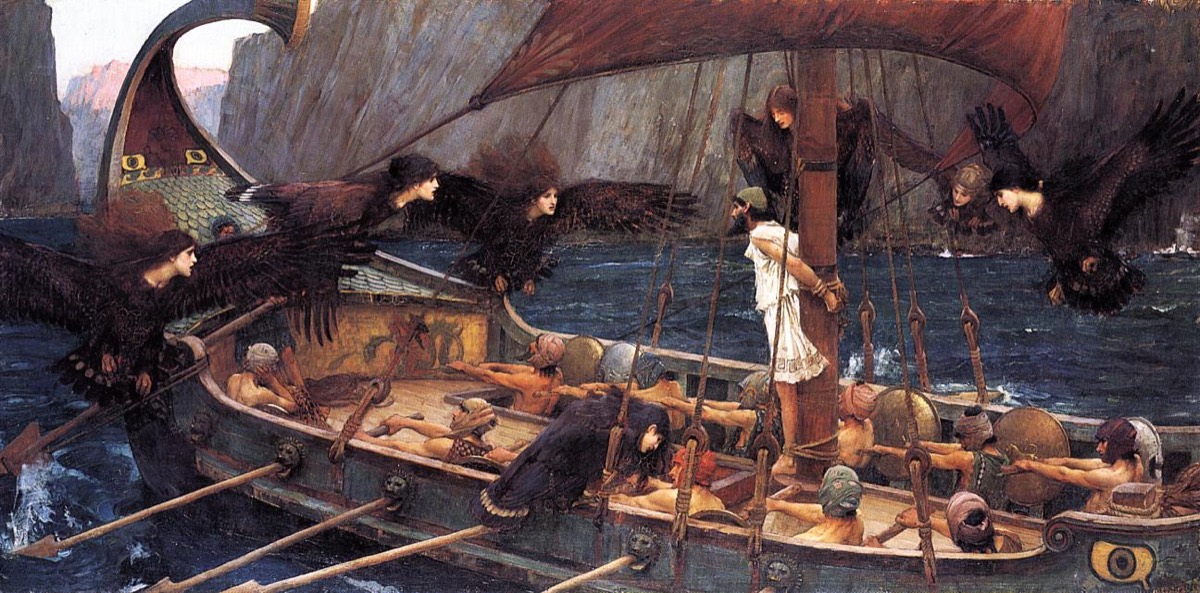 John William Waterhouse, Ulysses and the Sirens (1891). Exhibit A for item one: wings and talons, not a fish tail in sight.
- The Sirens were not mermaids. Homer never describes them physically, and classical Greek art shows them as bird-women, closer to harpies than to anything with a fish tail. Their bait wasn't beauty either. They promise Odysseus knowledge, the full song of everything that happens on earth. The seductive mermaid version is a much later invention.
- Scylla and Charybdis are two different monsters, not a saying. Scylla is a six-headed creature on a cliff who takes six sailors; Charybdis is a whirlpool that can swallow the whole ship. Odysseus is advised to hug Scylla's side and lose six men rather than risk everyone, which is why "between Scylla and Charybdis" means choosing the lesser of two evils.
- The Trojan Horse story you remember isn't from the Odyssey. The Iliad ends before the fall of Troy, and the Odyssey only glances at the horse in retrospect, most memorably when a court bard sings of it and the still-unnamed Odysseus breaks down weeping. The full wooden-horse story comes from Virgil's Aeneid, a Roman epic written some seven centuries later.
- Calypso, not Circe, kept him longest. Seven years versus one.
- It wasn't ten years of nonstop adventure. The monsters cluster in roughly the first year; most of the decade was captivity. Eight of the ten years were functionally house arrest with ocean views.
Is The Odyssey a true story?
No. It's legend, not history. The gods, the monsters, and Odysseus himself all belong to myth. But the poem's world touches real places and possibly real memory. Troy existed. The mound of Hisarlik in modern Turkey, excavated since the 1870s, matches the ancient descriptions of the city's location, and some archaeologists think a Late Bronze Age conflict there left the memory the epics grew from.
The Troy story usually leaves out one caution. Heinrich Schliemann, the man who famously "found Troy" in the 1870s, was also spectacularly wrong about it. He celebrated a layer of the city roughly a thousand years too old to match the story's Mycenaean world, and he got there partly with dynamite, wrecking evidence as he went. What remains is a kernel of possible historical memory wrapped in centuries of oral storytelling.
As for Homer himself, scholars call it the Homeric Question: whether one blind bard from the 8th century BCE composed the epics, or whether "Homer" is the name tradition gave to generations of oral poets whose songs were finally written down. The formulaic, repeated phrases in the poems are fingerprints of composition by performance, songs shaped by singers over centuries, and nobody knows which answer is right.
What the movie changes
First, the facts, none of which will spoil anything. Nolan wrote and directed; Universal released it wide on July 17, 2026; it runs roughly two hours and fifty-three minutes, carries an R rating, and is the first feature film shot entirely with IMAX film cameras, on a reported $250 million budget. It opened to $124.5 million domestically and $264 million worldwide, his biggest global opening yet, and its Rotten Tomatoes score has settled at 95 percent, the highest of his career.
The confirmed cast reads like the poem's roll call: Matt Damon as Odysseus, Anne Hathaway as Penelope, Tom Holland as Telemachus, Zendaya as Athena, Charlize Theron as Calypso, Robert Pattinson as Antinous (the worst of the suitors), Jon Bernthal as Menelaus, and John Leguizamo as the swineherd Eumaeus.
Reviewers flag two changes. The language is modernized, and the gods, ever-present in Homer, are pulled far into the background, which critics call one of the film's most divisive choices. Nearly all of them land in the same place, calling this Nolan's own creation rather than a faithful translation. The poem has survived worse retellings than this one.
Why a rewards platform cares about a 2,800-year-old poem
Full disclosure: you're reading this on a site where the points are called Laurels, the membership tiers are a pantheon, and the monthly competition is literally named the Arena. We built Earnopolis out of Greek mythology on purpose. When the movie of the year is Homer, this is our Super Bowl.
We'll spare you the strained metaphor about long journeys and earning your rewards. (It was right there. We're showing restraint.)
If this sends you down the mythology rabbit hole, we keep a running guide to Greek mythology in modern media, from Hades to Lore Olympus, and a lighter look at what ancient Greek money wisdom still works.
Quick answers
The short versions, for anyone who scrolled straight here.
Is The Odyssey a true story? No, it's an epic poem and legend. Troy was a real place (Hisarlik in modern Turkey) and a real Bronze Age conflict may echo behind the tradition, but the hero, gods, and monsters are myth.
How long was Odysseus's journey? Ten years from Troy to Ithaca, on top of the ten-year war, so twenty years away in total. Most of the travel decade was spent captive: seven years with Calypso and one with Circe.
How old is The Odyssey? Roughly 2,700 to 2,800 years old, usually dated to the 8th century BCE, and it grew out of an even older oral tradition before being written down.
Did Homer actually exist? Nobody knows for certain. Tradition describes a blind bard, but scholars debate whether one poet or generations of oral singers composed the epics; it's called the Homeric Question.
What is the movie The Odyssey based on? Homer's ancient Greek epic poem of the same name. Christopher Nolan's 2026 film adapts the full arc of the story, with Matt Damon as Odysseus, though reviews describe it as Nolan's own take, with modernized language and the gods pulled into the background.
What does the word "odyssey" mean? Originally just "the story of Odysseus." Because of this poem, it now means any long, eventful journey, a sense English picked up in the 19th century.
See the movie, then read the poem
Homer never explains who Odysseus is or why he's been gone twenty years. He didn't have to. In his world, everyone already knew this story, the way you know Cinderella. Twenty-eight centuries later, a director just spent $250 million retelling it, and everyone walking into the theater will already know how it goes.
Go see it big; it was shot for the biggest screens that exist. And if you walk out wanting the version with the bird-women, the seven-year island, and the bed built around a living olive tree, the poem is right there. It's been waiting longer than anyone.
Related reading: Greek mythology in modern media, 5 ancient Greek money hacks that still work, the Earnopolis Arena.
Ready to get started?
Create a free Earnopolis account